Why Local LLMs + AI Agents Make More Sense Than Ever
This morning, many users reported and observed something frustrating: Google’s Gemini was having issues. Requests stalled, sessions failed, and for some people the service became temporarily unusable.
Annoying? Sure.
But if you’re experimenting with AI agents—or even building parts of your daily workflow around them—it raises a much bigger question:
What happens when your AI workforce depends entirely on somebody else’s cloud?
If your agents rely on Google Gemini, OpenAI models, or any other online-only service, an outage doesn’t just interrupt one conversation. It can break an entire chain of automation:
- Your morning briefing never gets generated.
- Email triage stops halfway through.
- Notes don’t get summarized.
- Research agents stall.
- Document workflows hang in a queue.
- Smart home or business automations suddenly lose their “brain.”
One unavailable API, and your carefully built workflow can become surprisingly fragile.
The Local Advantage
Now imagine a different setup.
Instead of outsourcing every task to a cloud model, your core agent system runs on a local model through Ollama, LM Studio, or another on-device inference engine.
Suddenly, many daily routines continue as if nothing happened.
Your local agents can still:
- Summarize emails
- Classify documents
- Search your personal knowledge base
- Organize files
- Extract action items
- Generate routine reports
- Prepare meeting notes
- Manage task lists
- Query your Obsidian vault
- Coordinate other tools and scripts
None of these tasks necessarily require the most powerful frontier model on the planet.
In fact, many everyday workflows are repetitive, structured, and highly contextual—exactly the kind of work smaller local models can handle well.
Reliability Is a Feature
A lot of people evaluate AI only by one metric:
“Which model is smartest?”
That matters.
But in production, reliability often matters more than raw intelligence.
An agent that is available 24/7, runs without vendor rate limits, works even when cloud access is down, and doesn’t suddenly fail because of a provider issue can be more useful than a “smarter” model that occasionally disappears.
Local models give you:
- No API downtime dependency
- No per-token API bills
- No vendor rate limits
- Better privacy when data stays local
- Faster local iteration
- Full control over upgrades and versions
And perhaps most importantly:
Predictability.
That said, local AI is not free. You still pay in hardware, power, maintenance, and your own time. The tradeoff is not “free versus expensive.” It’s control and continuity versus convenience and raw capability.
The Hybrid Model: Best of Both Worlds
The real power comes from combining local models with cloud intelligence.
Instead of asking:
“Should I use local or cloud?”
Ask:
“Which tasks actually need cloud-level reasoning?”
A robust agent architecture might look like this:
Tier 1 — Local by Default
Handled locally:
- Scheduling
- Summaries
- File organization
- Knowledge retrieval
- Routine email drafting
- Personal data analysis
- Workflow orchestration
Tier 2 — Cloud When Needed
Escalated to cloud models only for:
- Complex reasoning
- Deep research that benefits from broad model capability
- Advanced code generation
- Multimodal analysis
- Large-context synthesis
- Higher-stakes creative work
Tier 3 — Fallback Logic
If the cloud provider is unavailable:
- Continue local tasks
- Queue non-urgent cloud requests
- Skip optional high-compute tasks
- Retry automatically later
That means when Gemini goes down, your system doesn’t fail.
It simply says:
“Cloud reasoning temporarily unavailable. Core workflows continue.”
A Note of Fairness
Before this turns into “local good, cloud bad,” let me be clear:
I genuinely love what Google Gemini, OpenAI, Anthropic, and other online AI platforms have made possible.
The speed of innovation is incredible. The reasoning power of these frontier models can be astonishing. For deep research, complex analysis, creative brainstorming, coding challenges, and those moments when you need a model that can connect dots across enormous amounts of information, cloud AI is often unmatched.
This isn’t an argument against online AI.
It’s an argument against single points of failure.
The goal isn’t to replace cloud intelligence. The goal is to build systems that continue working when the internet, an API, or a provider has an off day.
I still happily use Gemini. I still reach for cloud models when I need that extra horsepower.
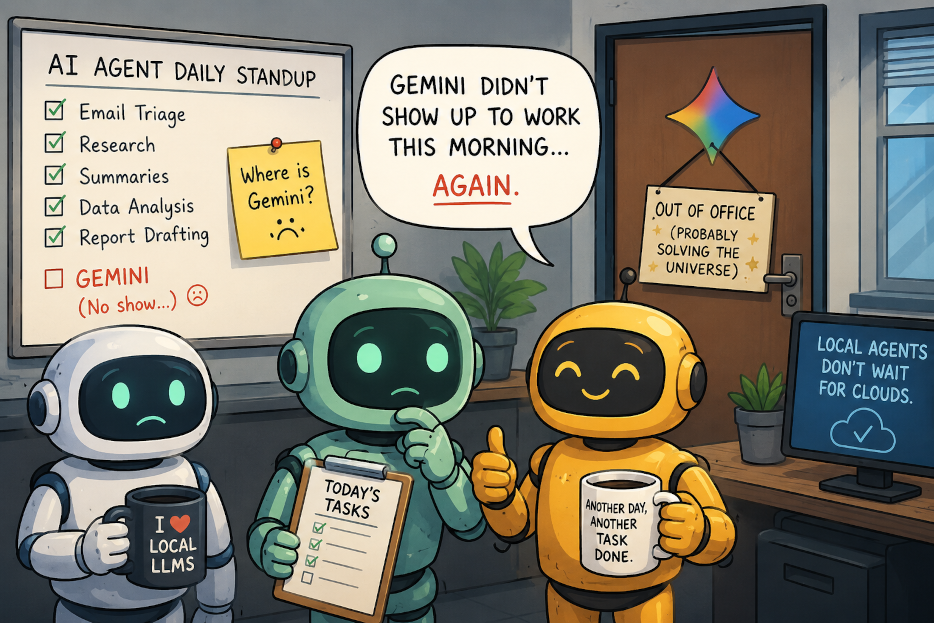
I just don’t want my entire digital workforce taking an unexpected coffee break because one brilliant colleague didn’t show up to work this morning.
That’s why, for me, local models aren’t a replacement.
They’re the dependable coworkers that keep the office running while the superstars are temporarily out solving the universe.
Outages Are Not Rare—Dependency Is the Risk
Today it’s Gemini.
Tomorrow it could be another provider, another API, another billing hiccup, another regional outage, or another rate-limit issue.
Cloud AI is powerful.
But dependency is expensive in ways most people don’t discover until something breaks.
A local LLM combined with intelligent agent routing doesn’t just make your workflow faster or cheaper.
It makes it resilient.
And in the coming years, resilience may turn out to be one of the most underrated features in AI.