The Digital Avalanche: Why I Refused to Let AI Sort My Family Photos
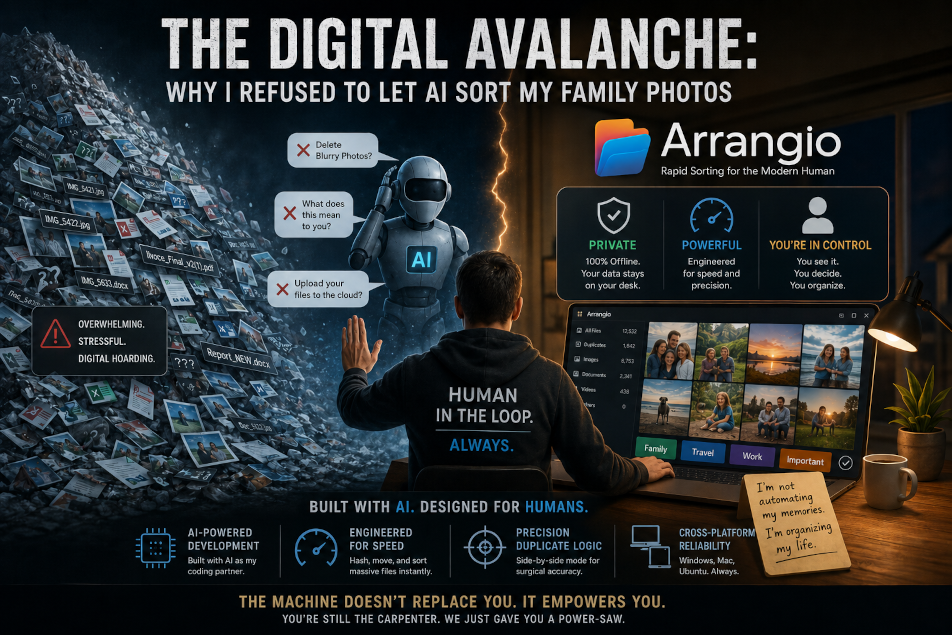
We’ve all been there. You plug in an old external hard drive, or open that “Downloads” folder, and you’re met with a digital landslide. Thousands of photos named IMG_5421.jpg and documents like Invoice_Final_v2(1).pdf. It’s overwhelming. It’s stressful. It’s Digital Hoarding.
Lately, the buzzword solution to everything is: “Just let an AI agent handle it.” But when I sat down to design Arrangio, I realized something that might surprise you: For your most precious memories and sensitive files, a fully automated AI is the wrong tool for the job.
Here is why I built a manual tool in an automated world—and how I used AI to do it.
The Mirage of “Fully Automated” Sorting
It sounds like a dream. You click a button, and an AI “magically” organizes your life while you grab a coffee. But in practice, fully autonomous sorting hits three major walls:
1. The Trust Gap (The “Grandma” Rule)
Would you let an invisible algorithm decide which of your family photos are “blurry” and should be deleted? AI is efficient, but it doesn’t have a heart. It might delete a low-quality, out-of-focus photo that happens to be the only picture you have of a loved one. When it comes to memories, “Human-in-the-Loop” isn’t a limitation—it’s a requirement.
2. Meaning vs. Metadata
An AI can identify a “dog on a beach,” but it doesn’t know that photo belongs in your “Summer of ’24” folder or your “Desktop Backgrounds” collection. AI groups things by what they are; humans group things by what they mean.
3. The Privacy Fortress
To let a cloud-based AI agent sort your files, you often have to upload them to a server. Do you really want to feed your private tax returns, medical records, and family moments into a corporate database? I designed my Arrangio to work 100% offline. Your data stays on your desk, where it belongs.
“I didn’t want a robot to clean my house while I was gone; I wanted a high-powered vacuum that made cleaning it myself feel like a breeze.”
The Paradox: Built with AI, but not for AI
There is a bit of irony here. While I don’t trust an AI to decide which of my photos to keep, I used AI as my Lead Architect to build the software.
By collaborating with advanced AI models, I was able to write the engine in C++—the gold standard for high-performance software. Using AI as a coding partner allowed me to:
- Engineered for Speed: The app can hash and move massive files instantly without your computer breaking a sweat.
- Precision Duplicate Logic: AI helped me design the “Side-by-Side” mode that catches duplicates with surgical accuracy.
- Cross-Platform Reliability: We used AI to ensure the code works perfectly whether you’re on Windows, Mac, or Ubuntu.
The Result: Rapid Sorting for the Modern Human
Arrangio isn’t about letting a computer take over your life. It’s about giving you a lightning-fast, distraction-free interface to make decisions.
Instead of a messy folder, you get a high-speed curation gallery. You see the file, you see the preview, and you click a category. Done. It’s the difference between using a hand-saw and a power-saw; you’re still the carpenter, but the work is finished in a fraction of the time.
We are living in an age where AI can do almost anything, but that doesn’t mean it should. Sometimes, the best use of technology is to get the machine out of the way so the human can finally get organized.
What do you think? Are you ready to regain control of your digital attic, or are you still waiting for the robots to get it right?